


Verbatim recall on your own machine.
Governed memory across AIs and people.
MemPalace is a popular, MIT-licensed, local-first memory system that stores coding-agent and project history word for word and serves it over MCP. Kemory captures chats across consumer AIs, recalls them in any AI, and lets you share memory with other people under consent and audit.
Last verified 7 November 2026 against primary sources
Two good answers.
Different jobs.
- You want memory that stays on your machine unless you opt in, at no cost.
- Your AI work happens mainly in Claude Code, Codex or Cursor and you want those sessions saved verbatim.
- You want to choose the storage back end: ChromaDB, SQLite, Milvus, Qdrant, pgvector or a native Rust engine.
- Your chats live in ChatGPT, Claude, Gemini, Perplexity, Manus and Grok, and you want them captured automatically.
- You need to share memory with other people, across organisations, with consent, credit, audit and revocation.
- You want summaries and one synthesised context, plus Ask Kora, Counsel and continuing a chat in another AI.
See each one
doing its job.
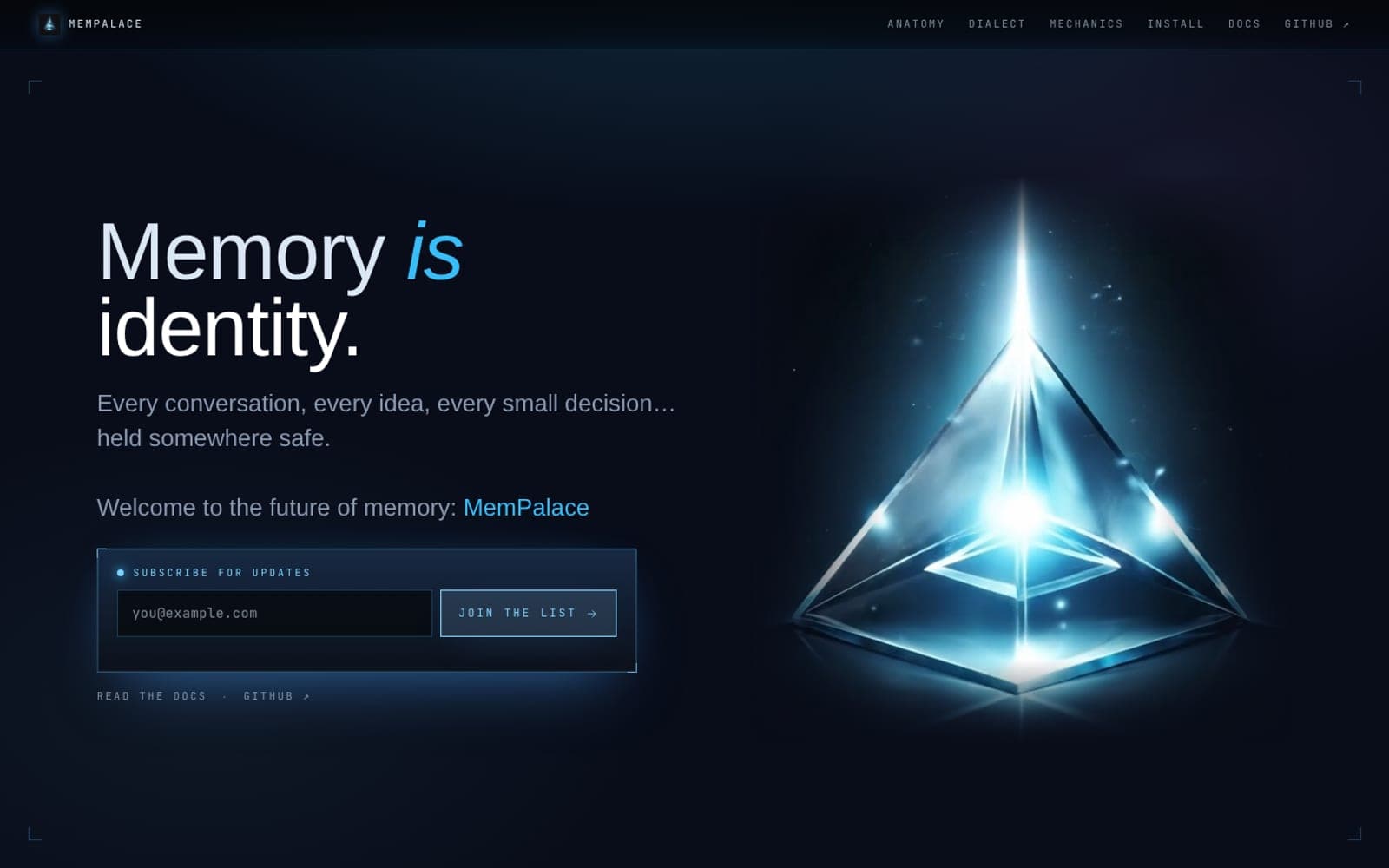
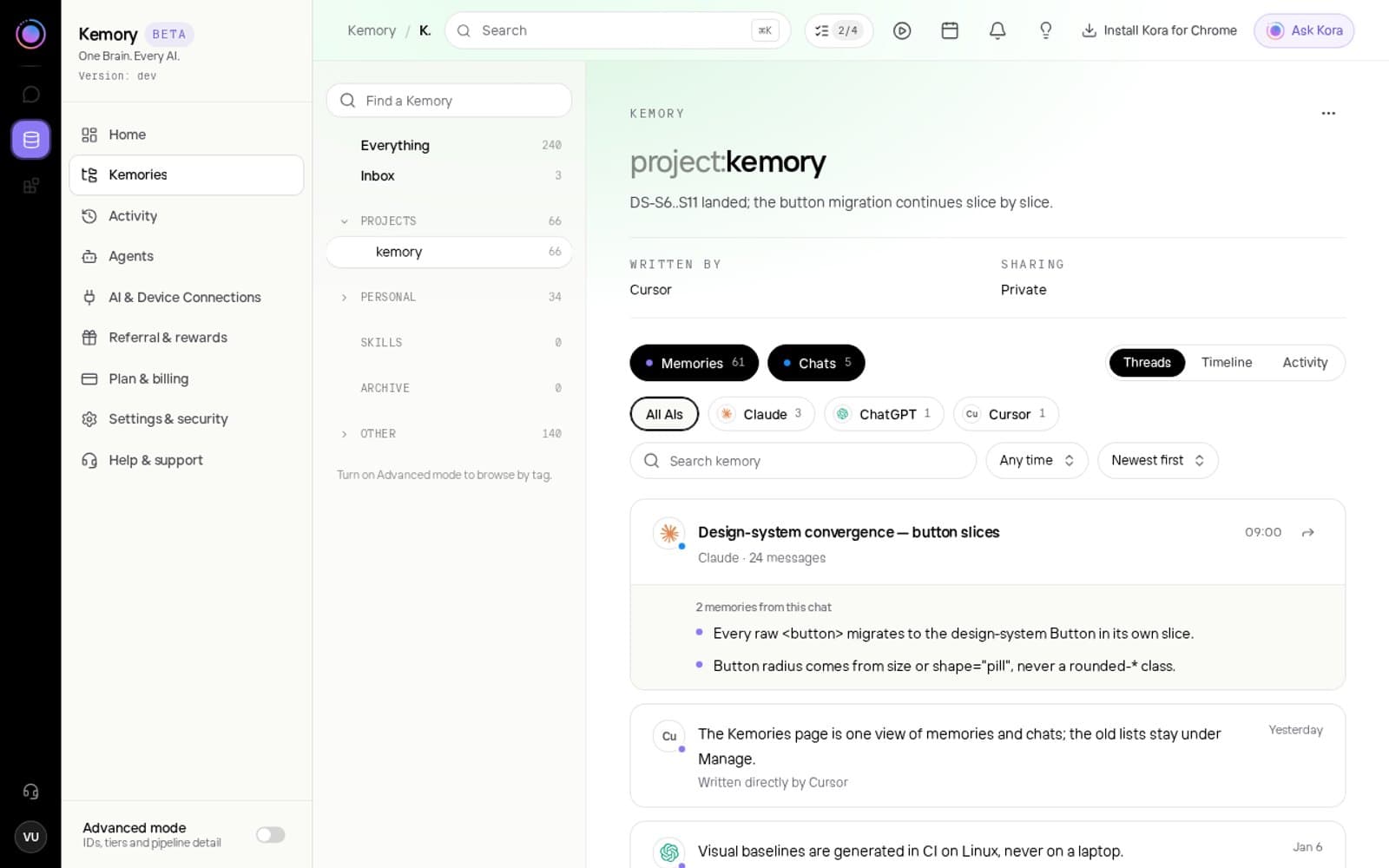
Screenshots taken 7 November 2026. MemPalace is a trademark of its owner, shown here to identify the product.
At a glance
The same rows on every comparison, so you can read one page against another.
*89.6% end-to-end answer accuracy on LongMemEval-S, open-weight Llama-3.3-70B reader, six runs. See the benchmarks or the full method on docs.sekondbrain.ai. A dash means not documented, not proven absent.
The same job,
done two ways.
MemPalace is fully local with no account or cloud required, free under MIT, and backed by a very large community with frequent releases. Its coding-agent hooks and transcript backfill go deep, and its public history file records benchmark corrections openly.
The numbers,
and how each was run.
These rows use different datasets, splits, readers and retrieval budgets, so they cannot be compared directly. We publish the method, every run including the lower ones, and use an open-weight reader rather than a frontier model.
| Product | Benchmark | Score | What it measures | Setup | Reader model | Runs |
|---|---|---|---|---|---|---|
| Kemory | LongMemEval‑S | 89.6% | End-to-end answer accuracy | 500 questions, oracle split | Llama-3.3-70B (open-weight) | Six, with variance |
| MemPalace | LongMemEval (raw) | 96.6% | Retrieval recall R@5, self-reported | 500 questions, no LLM | None (retrieval only) | Not stated |
| MemPalace | LongMemEval (hybrid) | 98.4% | Retrieval recall R@5, self-reported | 450-question held-out set | Not stated | Not stated |
What changed at MemPalace
Products move quickly. These are the dated changes this comparison has been checked against.
- 11 April 2026Warning about impostor domains distributing malware; official surfaces named.
- 14 April 2026Benchmark tables rewritten after a community audit; “100%” and “+34% palace boost” claims removed.
- 23–31 August 2026v3.8.0 and v3.9.0 released.
- 16 September 2026v3.10.0: light three-tool MCP server and shared-brain identity rules.
- 14 October 2026v3.11.0: palace audit and repair, opt-in multimodal embedder.
Specialists do one job well.
Kemory holds the thread across them all.
Every year brings better models and you will keep trying them. Kemory sits above the models rather than inside any one of them, so what you have worked out goes with you.
Tell one AI something once, and every AI you use just knows it. Start a thought in one and carry on in another, mid-sentence.
Every memory is permissioned and every change is provable. We do not train on your data. Delete anything, and prove it is gone.
Compaction runs on an open-weight model, so the frontier model only ever sees the compacted version — not the pile.
Already using MemPalace? You do not have to replace it to try Kemory. Kemory connects to the AIs you use over MCP and Kora for Chrome.
Choosing MemPalace instead?
Good — it fits you better right now.
Come back to Kemory when cross-AI, governed memory is what you need.
Five questions,
Kemory vs MemPalace.
- What is the difference between Kemory and MemPalace?
- MemPalace stores your coding-agent and project history verbatim on your own machine and serves it over MCP. Kemory captures conversations across consumer AIs in the browser, recalls them in any AI, and lets you share memory with other people under consent and audit.
- How are MemPalace and Kemory priced?
- MemPalace is free and open source under MIT; no paid tier is documented as of 7 November 2026. Kemory is free for 2,000 memories and two AIs, with Pro at $19.99 a month, Team at $30 a seat and Business at $55 a seat (10-seat minimum).
- Are MemPalace’s benchmark scores comparable with Kemory’s?
- No. MemPalace reports retrieval recall (R@5) on LongMemEval, which measures whether the right evidence is retrieved. Kemory reports 89.6% end-to-end answer accuracy on the LongMemEval-S oracle split with an open-weight Llama-3.3-70B reader, across six runs, which measures whether the final answer is right. MemPalace’s own history file makes the same distinction.
- Can I share a MemPalace with my team?
- Yes. Setup can create a shared-brain hub or a team server with Docker Compose, with rules keyed on host, harness and project; a consent flow and access audit log are not documented as of 7 November 2026. Kemory shares across organisations with accept-to-receive, credited contributions, audited reads and revocation.
- Is MemPalace still maintained?
- Yes. v3.11.0 was released on 14 October 2026, after four releases between mid-August and mid-September 2026. Its official surfaces are the GitHub repository, PyPI and mempalaceofficial.com.
More comparisons
Credit where it’s due. The real difference, either way.