


Managed memory for agents you run on AWS.
A cross-AI memory people and agents share.
Amazon Bedrock AgentCore Memory gives agents short-term events and long-term records extracted by managed strategies, including episodic memory with reflection, under IAM and usage billing. Kemory serves a wider job: it captures people’s chats across six AIs and shares memory across organisations, with consent and a hash-chained audit trail.
Last verified 7 November 2026 against primary sources
Two good answers.
Different jobs.
- Your agents already run on AWS and you want memory under the same IAM, VPC, KMS and bill.
- You want managed extraction strategies, including episodic memory with reflection, without running a pipeline.
- You need per-user isolation inside your own application at cloud scale, enforced by policy.
- You want memory that captures people’s chats in ChatGPT, Claude, Gemini, Perplexity, Manus and Grok, not only your agent’s sessions.
- You need sharing between people and organisations, with accept-to-receive, credited contributions and audited reads.
- You want one memory reachable from Claude, ChatGPT, Cursor and Claude Code over MCP, independent of any one cloud.
See each one
doing its job.
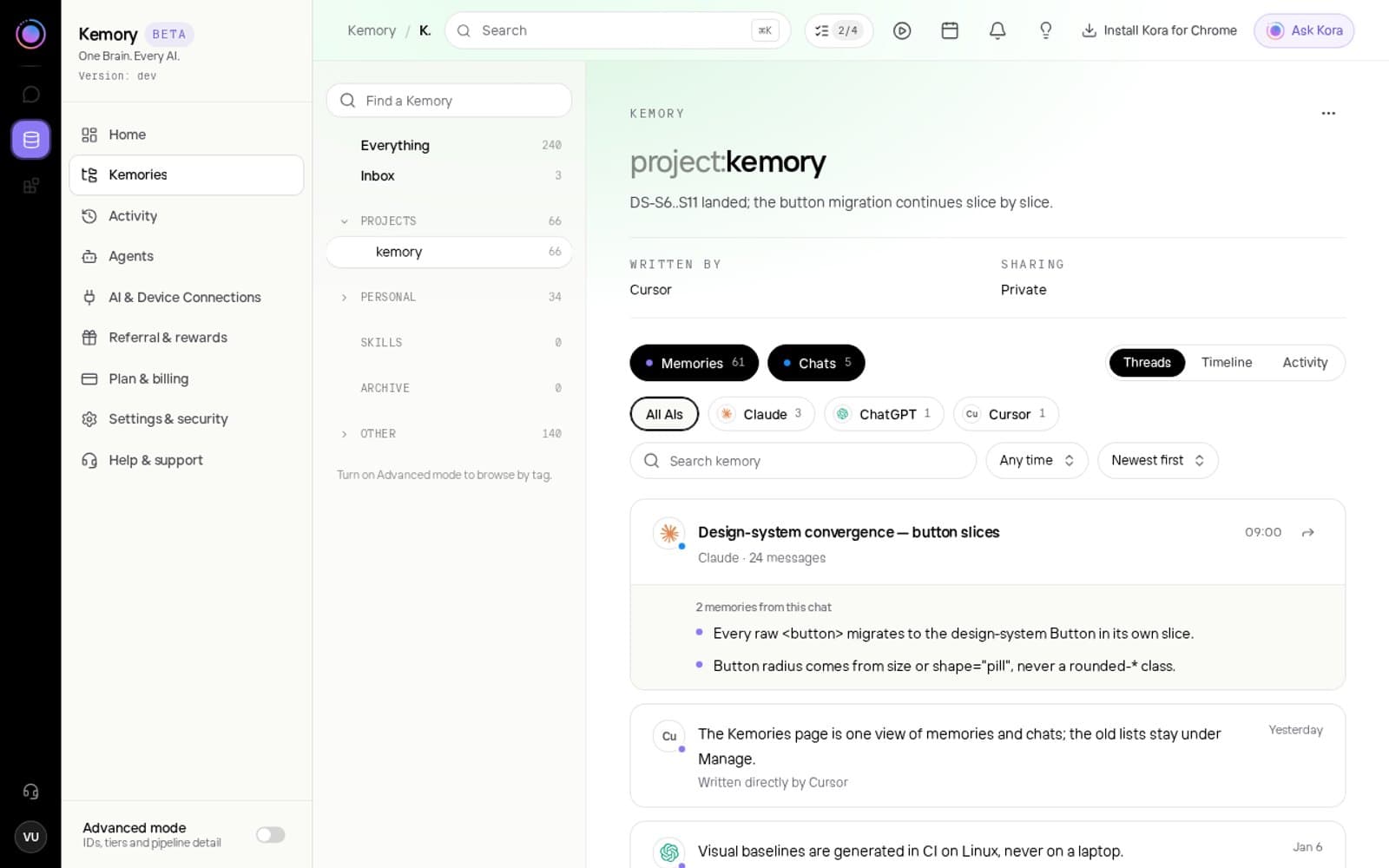
Kemory screenshot taken 7 November 2026. AWS AgentCore Memory is a trademark of its owner, named here to identify the product.
At a glance
The same rows on every comparison, so you can read one page against another.
*89.6% end-to-end answer accuracy on LongMemEval-S, open-weight Llama-3.3-70B reader, six runs. See the benchmarks or the full method on docs.sekondbrain.ai. A dash means not documented, not proven absent.
The same job,
done two ways.
For teams already on AWS, AgentCore Memory brings IAM, KMS, VPC, cross-account access and 16 Regions with no infrastructure to run. Managed strategies, episodic memory with reflection included, save building an extraction pipeline, and AgentCore Gateway can enforce per-user access with deny-by-default policies outside application code.
The numbers,
and how each was run.
These rows use different datasets, splits, readers and retrieval budgets, so they cannot be compared directly. We publish the method, every run including the lower ones, and use an open-weight reader rather than a frontier model.
| Product | Benchmark | Score | What it measures | Setup | Reader model | Runs |
|---|---|---|---|---|---|---|
| Kemory | LongMemEval‑S | 89.6% | End-to-end answer accuracy | 500 questions, oracle split | Llama-3.3-70B (open-weight) | Six, with variance |
| AWS AgentCore Memory | None published | — | — | — | — | — |
What changed at AWS AgentCore Memory
Products move quickly. These are the dated changes this comparison has been checked against.
- October 2025Amazon Bedrock AgentCore generally available.
- December 2025Episodic memory strategy documented.
- March 2026Memory record streaming and resource-based policies.
- August 2026Direct long-term ingestion, flexible namespaces, JSON events and AWS GovCloud (US-West).
- 6 October 2026Short-term memory moved from per-event to per-GB pricing; long-term record TTL followed in October.
Specialists do one job well.
Kemory holds the thread across them all.
Every year brings better models and you will keep trying them. Kemory sits above the models rather than inside any one of them, so what you have worked out goes with you.
Tell one AI something once, and every AI you use just knows it. Start a thought in one and carry on in another, mid-sentence.
Every memory is permissioned and every change is provable. We do not train on your data. Delete anything, and prove it is gone.
Compaction runs on an open-weight model, so the frontier model only ever sees the compacted version — not the pile.
Already using AWS AgentCore Memory? You do not have to replace it to try Kemory. Kemory connects to the AIs you use over MCP and Kora for Chrome.
Choosing AWS AgentCore Memory instead?
Good — it fits you better right now.
Come back to Kemory when cross-AI, governed memory is what you need.
Five questions,
Kemory vs AWS AgentCore Memory.
- What is the difference between Kemory and AWS AgentCore Memory?
- AgentCore Memory is a managed memory service for agents you build and run on AWS. Kemory is a memory for people, teams and agents across AIs: it captures chats from six AIs, recalls them over MCP, and shares memory across organisations with consent and audit.
- Can AgentCore Memory remember my ChatGPT or Claude conversations?
- No. It stores what your own agent writes. Kemory captures chats from ChatGPT, Claude, Gemini, Perplexity, Manus and Grok through Kora for Chrome.
- How are AgentCore Memory and Kemory priced?
- AgentCore Memory is billed by usage: short-term memory at $1.00 per GB ingested, $0.20 per GB retrieved and $0.10 per GB-month stored, and long-term memory at $0.75 per 1,000 records a month (built-in strategies) plus $0.50 per 1,000 retrievals. Kemory is free for 2,000 memories and two AIs, with Pro at $19.99 a month, Team at $30 a seat and Business at $55 a seat (10-seat minimum).
- Can I use Kemory with agents on AWS?
- Yes. Kemory’s MCP server, REST API, CLI and Python and TypeScript SDKs are cloud-independent, so agents running on AgentCore Runtime can call them.
- Where is my data kept?
- AgentCore Memory runs in the AWS Region you choose, from 16 Regions including Mumbai. Kemory keeps data in India for Indian users and in Switzerland otherwise, or in your own environment with enterprise self-host.
More comparisons
Credit where it’s due. The real difference, either way.