


A model of the conversation.
A governed memory across contexts.
Honcho, from Plastic Labs, reasons over the messages your app stores to model the people and agents in it. Kemory starts from the user: it captures chats across the major AIs, recalls them over MCP, and governs sharing between people.
Last verified 7 November 2026 against primary sources
Two good answers.
Different jobs.
- Modelling users and agents over time is central to your product, and you want natural-language answers about a peer.
- You want open-source, self-hostable memory infrastructure and can work with AGPL-3.0.
- You want multi-peer perspectives: what one agent or user knows about another.
- You want your own chats in ChatGPT, Claude, Gemini, Perplexity, Manus and Grok captured automatically, then recalled or continued in another AI.
- You need to share memory with other people across organisations, with accept-to-receive, revocation and audited reads.
- You want consumer and team plans at a fixed price per seat, rather than usage-based billing.
See each one
doing its job.

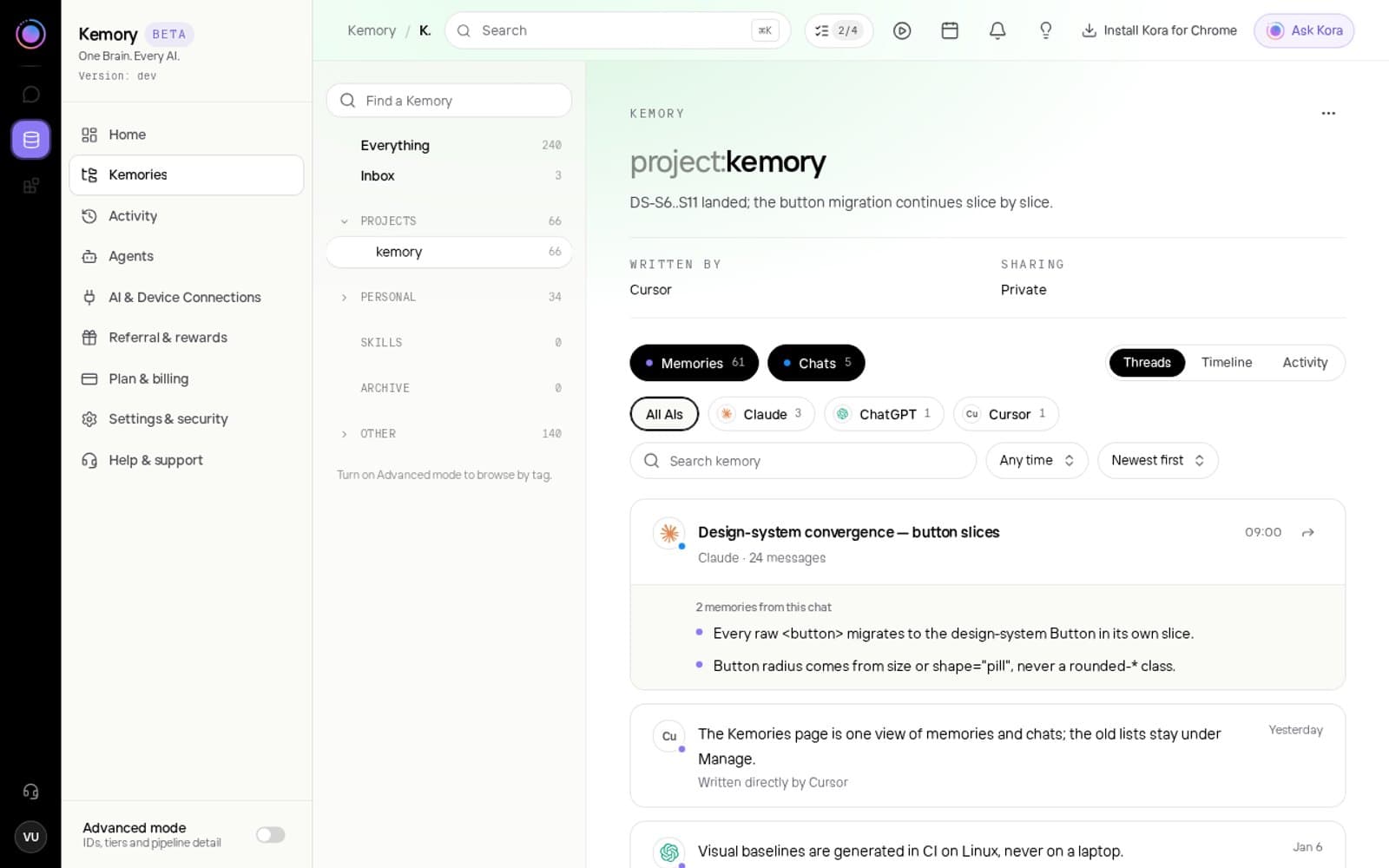
Screenshots taken 7 November 2026. Honcho is a trademark of its owner, shown here to identify the product.
At a glance
The same rows on every comparison, so you can read one page against another.
*89.6% end-to-end answer accuracy on LongMemEval-S, open-weight Llama-3.3-70B reader, six runs. See the benchmarks or the full method on docs.sekondbrain.ai. A dash means not documented, not proven absent.
The same job,
done two ways.
Honcho's peer-centric model is purpose-built for reasoning about people and agents over time. The whole server is open source and self-hostable today, and each derived conclusion cites the messages it came from.
The numbers,
and how each was run.
These rows use different datasets, splits, readers and retrieval budgets, so they cannot be compared directly. We publish the method, every run including the lower ones, and use an open-weight reader rather than a frontier model.
| Product | Benchmark | Score | What it measures | Setup | Reader model | Runs |
|---|---|---|---|---|---|---|
| Kemory | LongMemEval‑S | 89.6% | End-to-end answer accuracy | 500 questions, oracle split | Llama-3.3-70B (open-weight) | Six, with variance |
| Honcho | LongMemEval, LoCoMo | Not verified | Self-reported (“Pareto frontier”) | Not verified | Not verified | Not verified |
What changed at Honcho
Products move quickly. These are the dated changes this comparison has been checked against.
- August–November 2026Releases 3.1 to 3.6, every week or two.
- 29 October 2026v3.5.0: conclusions cite the messages they came from; peer chat answers in a single turn.
- 5 November 2026v3.6.0: optional multi-tenancy with Postgres row-level security; Representation History.
Specialists do one job well.
Kemory holds the thread across them all.
Every year brings better models and you will keep trying them. Kemory sits above the models rather than inside any one of them, so what you have worked out goes with you.
Tell one AI something once, and every AI you use just knows it. Start a thought in one and carry on in another, mid-sentence.
Every memory is permissioned and every change is provable. We do not train on your data. Delete anything, and prove it is gone.
Compaction runs on an open-weight model, so the frontier model only ever sees the compacted version — not the pile.
Already using Honcho? You do not have to replace it to try Kemory. Kemory connects to the AIs you use over MCP and Kora for Chrome.
Choosing Honcho instead?
Good — it fits you better right now.
Come back to Kemory when cross-AI, governed memory is what you need.
Five questions,
Kemory vs Honcho.
- What is the difference between Kemory and Honcho?
- Honcho is memory infrastructure for developers. It reasons over the messages your app stores to model users and agents. Kemory is a cross-AI memory for people and teams. It captures chats from the major AIs, recalls them over MCP, and governs sharing with consent and audit.
- Does Honcho support more than one kind of peer?
- Yes. Honcho's documentation describes peers as users, agents, groups, projects and ideas. When configured, it can model what one peer knows about another.
- Can I self-host Honcho?
- Yes. The server is open source under AGPL-3.0. You can run it with honcho start, with Docker Compose, or from source. A managed service also runs at api.honcho.dev, with a dedicated instance for each organisation.
- How are Honcho and Kemory priced?
- Honcho is usage-based: new accounts get a $5 credit, then $5 a month with a card on file. Kemory is free for 2,000 memories and two AIs, with Pro at $19.99 a month, Team at $30 a seat and Business at $55 a seat.
- How do Honcho's benchmarks compare with Kemory's?
- Not directly. Honcho's README cites evaluations on LongMemEval and LoCoMo, but we could not verify the scores, split or reader. Kemory publishes 89.6% end-to-end answer accuracy on the LongMemEval-S oracle split with an open-weight Llama-3.3-70B reader, across six runs.
More comparisons
Credit where it’s due. The real difference, either way.